
02·Thesis & Research · 2026

A neural network that picks the right steel connection.

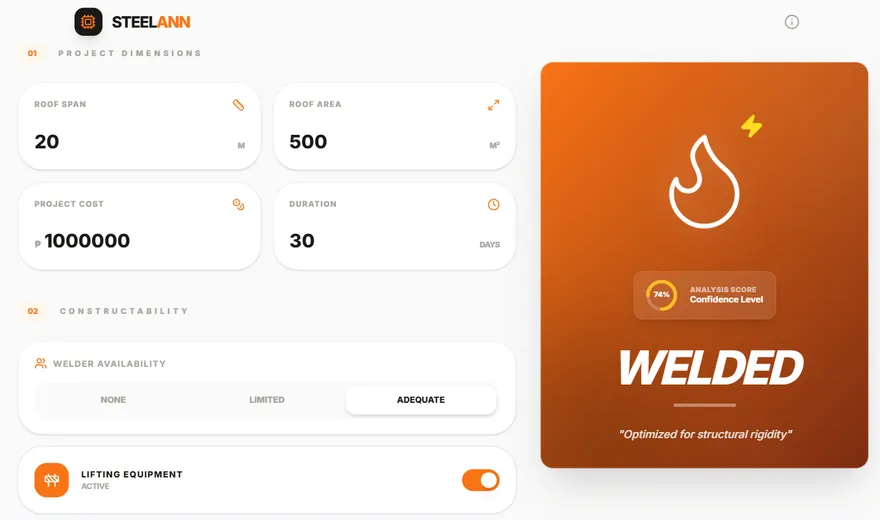
An artificial neural network that takes structural design inputs and predicts the appropriate steel connection type, built for a graduate thesis and deployed as a working web tool the panel could use during the defense.

Open the live tool
Screenshot of the Steel Connections Classifier, a neural network tool that predicts steel connection types

At a glance

Client
Graduate structural-engineering research project
Year
2026
Built with
  • Artificial neural network
  • Python
  • Multi-class classification
  • Held-out test evaluation
  • Web deployment

Outcome

Status
Deployed, public, and clickable today
Defense
Panel interacted with the live model, not a notebook
Evaluation
Held-out test set with per-class metrics and baselines

Overview

Choosing a steel connection is a judgment a structural engineer makes from a handful of design parameters, guided by code provisions and experience. The research question behind this project was whether that judgment is learnable from historical design decisions, and if so, whether a model could make it fast enough to be useful early in design, when engineers are still exploring options.

The deliverable was not a paper alone. It was a trained model, an honest evaluation of it, and a deployed interface the panel could operate during the defense.

The problem

Machine learning theses tend to fail in one of two places, and this project had to survive both. The first is data: what gets collected is often not in a shape a model can learn from. The second is justification. A model that works in a notebook but has no story behind why that architecture, and no comparison against anything simpler, does not survive a panel.

There is a third problem specific to defenses. A model demonstrated by scrolling through a notebook on a laptop asks the panel to take the student's word for it. A model the panel can type inputs into and watch respond is a categorically different kind of evidence.

The approach

The design inputs were structured into a clean tabular dataset with the connection type as the target, and the problem framed as multi-class classification. Categorical fields were encoded and numeric ones scaled, with the scaler fitted on training data only. Fitting it across the whole dataset leaks test information into training and quietly inflates every number you report afterwards.

An artificial neural network was chosen over a simpler classifier because the decision boundaries between connection types are not cleanly separable on the raw inputs. That choice was made against baselines rather than assumed: simpler models were trained first, precisely so the thesis could answer the question a panel always asks, which is why not something simpler.

Baselines before the neural network
Simpler classifiers were trained first to establish the floor. A neural network that cannot beat a decision tree is a finding worth knowing before you defend it, not after.
A held-out test set, never touched during training
Accuracy on data the model trained on is not a result. The reported numbers come from a split kept aside until the very end.
Per-class metrics, not just headline accuracy
A confusion matrix with precision and recall per connection type, because overall accuracy hides a model that is excellent on common classes and useless on rare ones.
Deployed for the defense
A web interface with a public URL, so the panel could put inputs in themselves and see what came back.

How it was built

The model was developed in Python and trained on the prepared dataset, with the architecture and training regime tuned against validation performance rather than test performance. The trained model was then wrapped in a web interface and deployed to a public URL.

The interface is deliberately plain. It takes the design inputs, returns the predicted connection type, and does nothing else. During a defense, anything more is a distraction from the model, and the model is the thesis.

Where it landed

The tool is live and publicly accessible, which is unusual for a thesis artifact; most end their life as a notebook on a student's laptop. The student defended with a working system the panel could operate, backed by evaluation numbers computed properly.

The more useful outcome for anyone reading this as a prospective client: this project is what a research engagement with Kleio actually produces. Not a report about a model, but a model, the evidence for it, and something you can click.

Want something like this built?

Tell us what you are trying to make, and you will get an honest answer on whether it is worth building, roughly what it takes, and whether we are the right people for it.

Book a free discovery call