
03·Thesis & Research · 2025

Recommending geotextile materials from site parameters.

A predictive model that recommends an appropriate geotextile material from measured site parameters, built for a master's thesis and deployed as a public tool.

Open the live tool
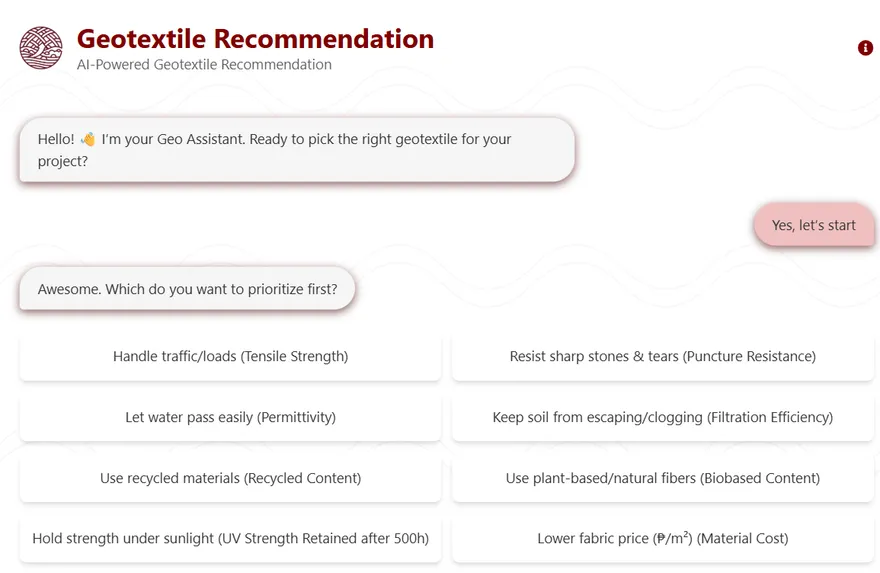
Screenshot of the Geotextile Material Predictor, a machine learning tool for geotechnical material selection

At a glance

Client
Master's-level geotechnical research project
Year
2025
Built with
  • Machine learning
  • Python
  • Tabular prediction
  • Feature engineering
  • Firebase Hosting

Outcome

Status
Deployed, public, and clickable today
Scope
Master's thesis, from data preparation to deployment
Output
A material recommendation from measured site inputs

Overview

Geotextile selection is a materials decision driven by site conditions: soil characteristics, the function the fabric has to perform, and the loading it will see. It is well-understood engineering, but it is also a decision made repeatedly from a similar set of measured inputs, which is exactly the shape of problem a predictive model can support.

This was a master's thesis. The scope ran from raw site data through to a deployed tool, which is a wider span than most academic machine learning projects attempt.

The problem

Geotechnical datasets are small. This is the defining constraint of the project and it shapes every decision downstream. A model that would be unremarkable on ten thousand rows becomes a genuine methodological problem on a few hundred, because the risk of a model that memorizes rather than generalizes rises sharply as the data shrinks.

Small data also makes evaluation harder. A single random train/test split on a small dataset produces a number that moves depending on which rows happened to land where, which is not a result you want to defend in front of a panel that knows this.

The approach

The site parameters were consolidated into a consistent tabular dataset, with units and naming reconciled across sources. That is routinely the largest single chunk of work in a geotechnical project, and the part nobody budgets for.

Given the data size, model selection favored methods that behave well on small tabular datasets over anything larger. This is the opposite of the instinct most students bring, which is that a more sophisticated architecture makes a better thesis. On a few hundred rows the more sophisticated architecture is usually a worse thesis, because it overfits and the panel knows it.

Model capacity matched to dataset size
On small tabular data the binding constraint is variance, not model expressiveness. Choosing a smaller model here is a defensible methodological decision, and the thesis argues it explicitly.
Feature engineering over raw inputs
Domain-meaningful derived features do more on a small dataset than extra model capacity does, and they are far easier to justify to a panel of engineers.
Evaluation that accounts for small-sample variance
A single lucky split is not evidence. Evaluation was structured so the reported performance reflects the model rather than the split.
Deployed as a usable tool
Site parameters in, material recommendation out, at a public URL.

How it was built

Python for the data pipeline and modeling, with the trained model served behind a web interface deployed on Firebase Hosting.

As with the steel connections tool, the interface does one thing: accept the inputs an engineer would have on hand, and return the recommendation. The value is in the model and the evidence behind it, not in the wrapper.

Where it landed

The tool is live and publicly reachable, and the research it supported ran to completion at master's level.

This project and the steel connections classifier together make a point worth stating plainly: the constraint on an academic machine learning project is almost never the modeling. It is the data, the evaluation methodology, and whether the student can explain the architectural choices in their own words. Those are the three things the work is actually organized around.

Want something like this built?

Tell us what you are trying to make, and you will get an honest answer on whether it is worth building, roughly what it takes, and whether we are the right people for it.

Book a free discovery call